
Partnership Background
The City of Edmonton is located on Treaty 6 Territory and on the Traditional Territory of Enoch Cree Nation. City of Edmonton shares a boarder with Enoch Cree Nation’s eastern edge.
Enoch Cree Nation and City of Edmonton participated in the CEDI program during Phase II as a part of Cycle I from 2016-2019.
Key Milestones and Collaborative Community Economic Development Initiatives
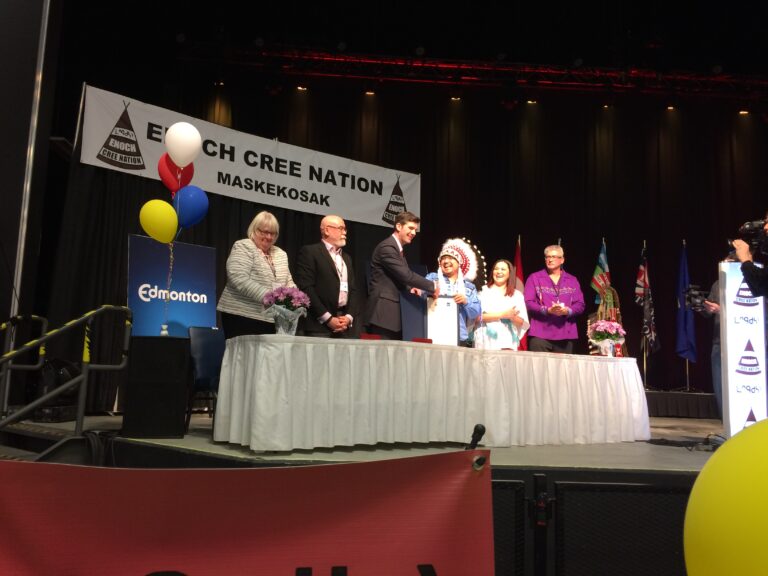
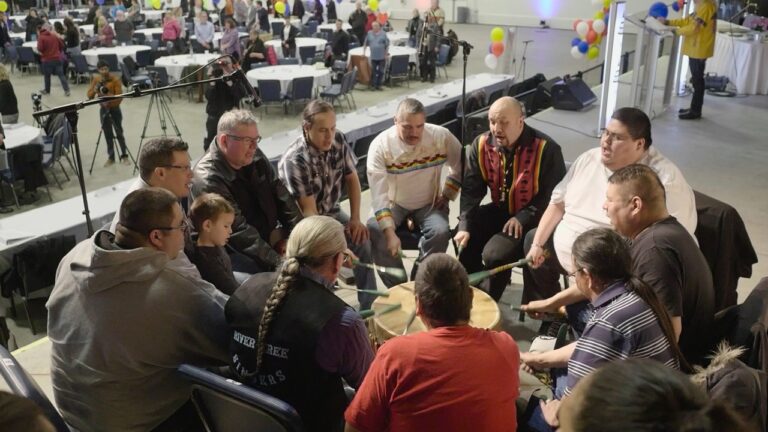
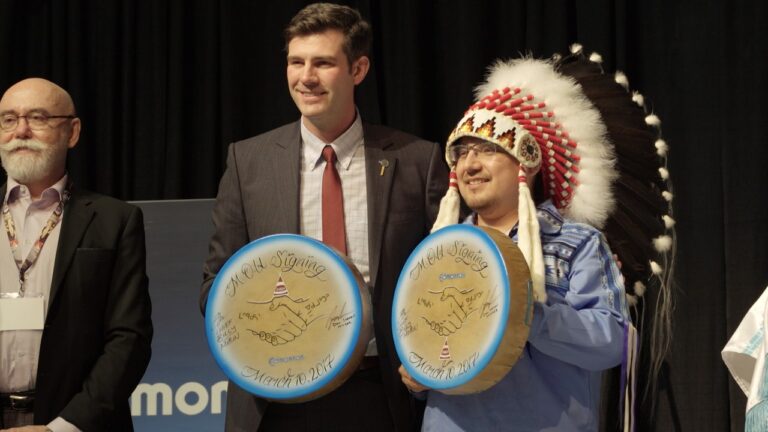
On March 9, City Council and Band Council members participated in a traditional sweat lodge, drumming, hand games and feast to enhance council-to-council relationship building. The MOU between Enoch Cree Nation-City of Edmonton was signed during a special community celebration and signing ceremony held on March 10, 2017, in conjunction with CEDI Workshop 2. The MOU signing and celebration gave the “go-ahead” to all levels of both communities to pursue collaboration. Both communities’ youth also took up the call to convene to explore issues and opportunities of shared interest. Edmonton’s Youth Council created a seat for an Enoch Cree Nation youth representative.
“At the MOU signing, one of my colleagues from Enoch said, “this is what reconciliation actually looks like” and that has really stuck with me. It’s our shared responsibility to maintain that momentum.”
– Enoch Cree Nation, CEDI Working Group Member June 2019
After five years of collaborating, the relationship was mainstreamed as the new way of doing business in both communities, as several departments and council members that were not involved in CEDI now collaborate directly. Even the two communities’ technical teams are learning to work together and collaborate on a variety of initiatives, including: development and co-management of a Provincial Park; boundary interface protocols and strategies (BIPS); establishing a transit connection between the two communities; shared fire services around their borders; urban reserve development; developing Edmonton’s Indigenous procurement strategy; supportive housing plans; and community education and awareness raising. The partnership leveraged $22.5 million in additional funding for their CED projects.
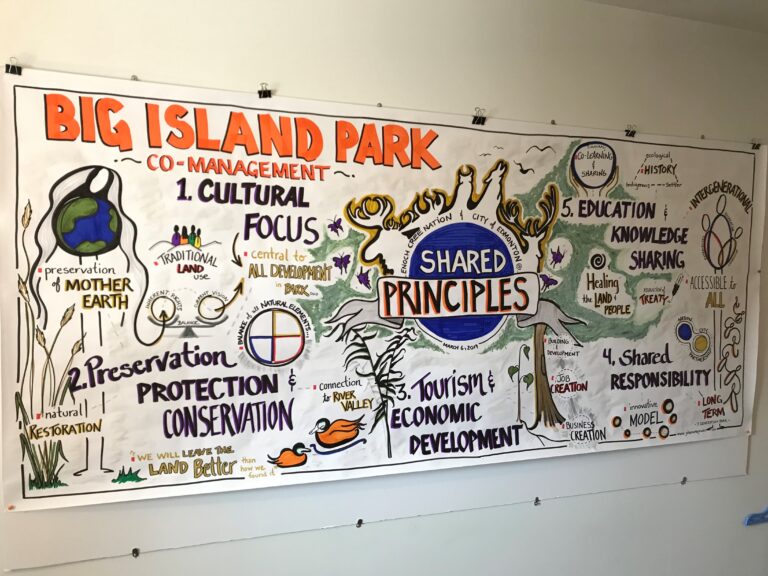
1. The Woodbend- Big Island Park: Co-managed Provincial Park and Tourism Strategy.
The Woodbend- Big Island Park presented an opportunity to co-manage a Provincial Park, situated within the City of Edmonton and recognized as meaningful traditional lands of the Enoch Cree Nation. To guide this work, the partners established a joint task team, leadership team, and executive team, with the task team meeting weekly to advance the project. Together, they co-developed a proposal for the park that included principles of co-governance, an intercultural approach that reflected both worldviews and served as an important learning experience for the partnership. The Government of Alberta committed $10 million to the initiative and began implementing it. In addition, the partnership undertook environmental and traditional land use studies, which strengthened collaboration between their respective technical teams and further deepened their working relationship.
2. Sports and Recreation collaboration
With sports facilities proposed for each community near Lewis Farms, Enoch Cree Nation and the City of Edmonton met to share plans and timelines to ensure coordinated regional planning and to maximize services for citizens on the reserve and in the city who lived in proximity to both facilities.
3. Permanent Supportive Housing
The partnership also explored joint supportive housing initiatives to address regional housing needs. Both communities worked to gather the necessary information and data to advance the project, including funding opportunities, land availability, and the specific needs of Enoch Cree Nation members.
4. Transit Connection
There was a strong need for a transit connection between the City of Edmonton and Enoch Cree Nation. In April 2018, a councillor for the City of Edmonton brought forward a motion to city council to explore this opportunity and later met with Enoch Cree Nation’s Chief and Council to discuss potential collaborations, including the secondment of Enoch staff to the City’s Transit Department to build capacity for future joint work. An important outcome of these efforts was the invitation for Enoch Cree Nation to join the Edmonton Metropolitan Regional Board’s emerging Regional Transit Services Commission, which formalized Enoch Cree Nation’s role in regional transit planning and collaboration
5. Boundary Interface Protocols Strategy (BIPS)
The BIPS provides a clear and concise framework to guide future collaboration on land use and infrastructure, while shaping policies and processes that support coordinated development along the shared boundary of Enoch Cree Nation, the City of Edmonton, and Parkland County. The document has already positively influenced a road expansion on the northern reserve boundary.
6. Fire Services
Following their time in the CEDI program, the new Edmonton Fire Chief met several times with the Enoch Fire Chief, expressing interest in strengthening their relationship. The two departments began discussions on joint training and learning opportunities and developed a shared vision for a joint fire hall on the southeast corner of the Enoch reserve, designed to serve both Enoch and the adjacent areas of Edmonton and Parkland County. This collaboration emerged as a clear example of the mainstreaming of partnership between the communities.
7. Urban Reserve Development
Edmonton City Council received a motion to develop an Urban Reserves strategy to ensure the City was prepared with a clear process to respond to First Nations undertaking an Addition-to-Reserve (ATR) process. To advance this work, Edmonton established a steering committee with representatives from Enoch Cree Nation, the Confederacy of Treaty 6, federal and provincial governments, and various city departments. With this strategy in place, Enoch submitted an urban reserve application to the City and pursued it under the new framework.
8. Indigenous Procurement
Edmonton had both a local and a sustainable procurement strategy and began creating an Indigenous procurement strategy to improve accessibility for Indigenous businesses. An Indigenous Procurement Advisory Committee, which included members from Enoch Cree Nation and private businesses, was active in this work and explored ways to incorporate Indigenous languages into tender reviews.
9. Educational videos
In November 2020, the partnership launched a three-part video series titled Past, Present, Future, which highlighted the communities’ histories, current relationships, and future commitments to work together. The videos were created as educational tools for elected officials and staff, while also serving to build greater awareness of the partnership within the broader community. These videos were financially supported by the CEDI capacity building grant.
In March 2017, Enoch Cree Nation and the City of Edmonton signed a historic MOU affirming their shared vision and commitment to joint economic development. The signing took place at a celebration attended by more than 400 elected officials, staff, and community members. Leading up to the event, both councils and staff participated in cultural preparation, including a pipe ceremony, sweat lodge, and cultural teachings. These experiences added meaningful depth to the signing, with the Chief emphasizing that the MOU represents a genuine commitment, “not just a piece of paper.” Since then, the MOU has been celebrated annually as a symbol of the partnership’s strength and ongoing collaboration.
In the Media
- March 11, 2017: Enoch Cree Nation set to develop urban reserve in Edmonton after signing partnership deal
- September 8, 2017: Mayor’s plan for provincial park in southwest Edmonton backed by Enoch Cree Nation
- May 2, 2018: Councillors propose transit link between Edmonton and Enoch Cree Nation
- June 29, 2022: Edmonton could be home to Alberta’s newest provincial park
Photo Gallery
Partnership Videos
Quotes
“Our teams now work together, and I like the exposure they get at the municipal level at those tables for development. This gives investors a lot of certainty and a lot of comfort knowing that we can build relationships with other jurisdictions.”
Chief Billy Morin, Enoch Cree Nation, AB
“We’ve been neighbours with Enoch Cree Nation for more than a century and yet it’s only in the last few years that we’ve started to act like neighbours. I think the most important thing about the work that we did, was we built relationships, we built friendships and we built trust.”
Mayor Don Iveson, Edmonton, AB
“The CEDI partnership has enabled us to get to know each other and learn about how each government (our First Nation and Edmonton) works. That collaboration is extended by the efforts made by our Chief Billy Morin with Mayor Don Iveson, our government staffs, our councils who are now interacting and involved with each other. Our group is successful because we created an environment of trust, understanding and collaboration. We are working on the steps that we need to take to lead towards a better future for us as neighbors together.”
Corina Hollingworth, Executive Director of Planning and Development, Enoch Cree Nation
“We went into this CEDI program thinking there would be a project (a road, a building) then we realised we aren’t getting to a project, but our project would be our relationship and our way of working together – and that was ok. Sometimes this work, if you focus too much on something specific, you may not see that this work is a generational shift and change, culture change, changing the way we work together as neighbours.”
Morgan Bamford, Indigenous Relations Consultant, City of Edmonton